
Sleep Apnoea (OSA): Symptoms, Diagnosis & Treatment in Klang, Malaysia
Could Your Snoring Be a Sign of Sleep Apnoea?
“Doctor, my wife says I stop breathing when I sleep.”
This is something I hear quite often in my clinic. The patient may have snored for years and thought nothing of it. What finally worries the family is the pause after the snoring. There may be several seconds of silence, followed by a gasp, snort or choking sound before breathing starts again.
Other patients come for a different reason. They sleep for seven or eight hours but wake feeling as though they have hardly rested. They struggle to stay alert at work, wake with headaches, become irritable or find themselves fighting sleep during the day.
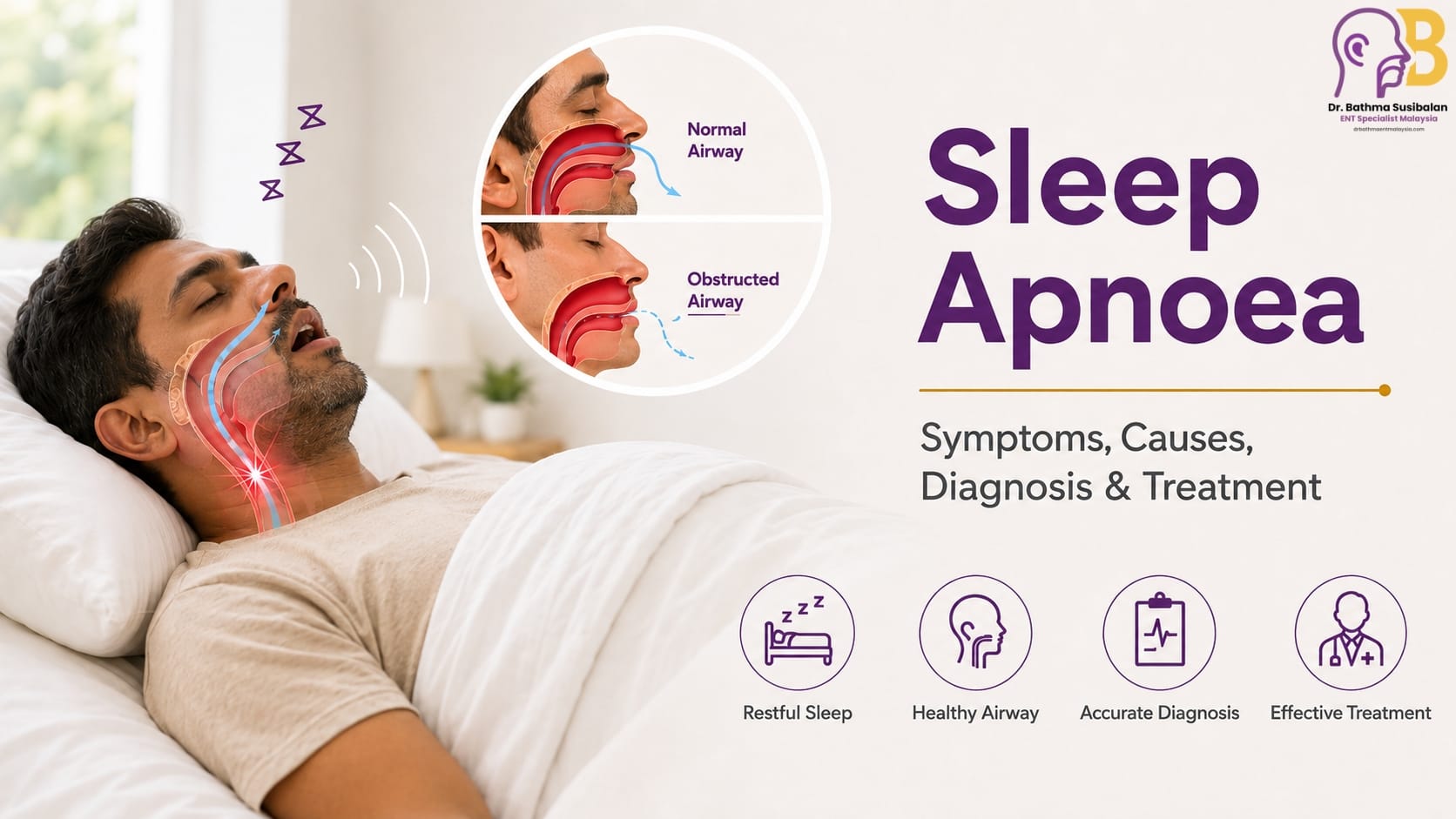
These can be signs of sleep apnoea. You may also see the condition written as sleep apnea, especially on international websites. The most common form is obstructive sleep apnoea, or OSA, where the upper airway repeatedly narrows or closes while you sleep.
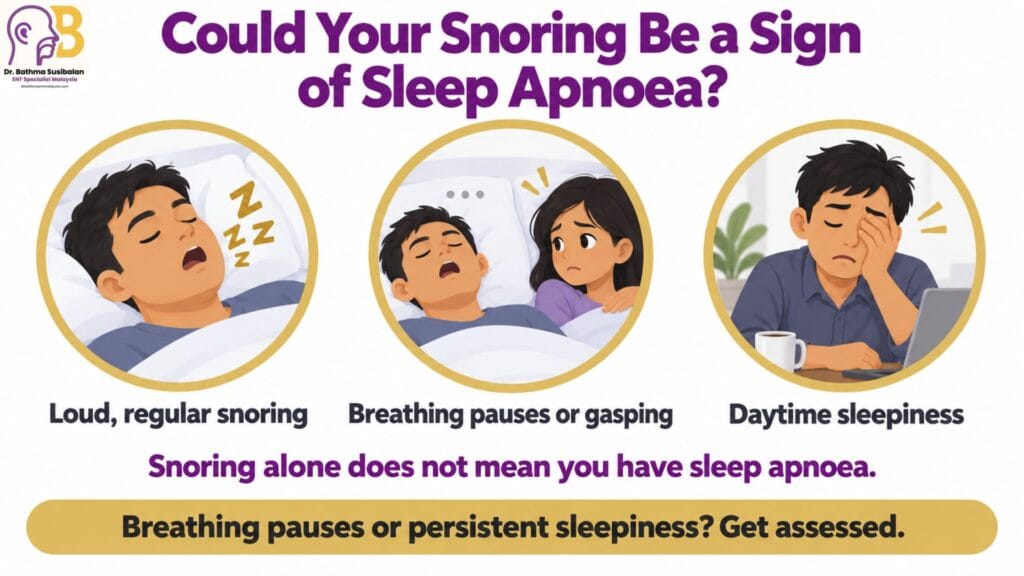
Not everyone who snores has OSA. But loud, regular snoring together with breathing pauses, gasping, choking or significant daytime sleepiness deserves a proper assessment.
I assess patients with snoring, sleep-disordered breathing and obstructive sleep apnoea at KPJ Klang Specialist Hospital. For patients searching for a sleep apnoea assessment in Klang or the wider Kuala Lumpur and Klang Valley area, my clinic is based in Klang, Selangor. My role as an ENT specialist is to look closely at the nose, tonsils, palate, tongue, throat and other parts of the upper airway that may be contributing to the problem.
In this guide, I will take you through the condition in the same order I usually explain it to patients: what OSA is, what symptoms to look for, what may be causing it, when to seek help, how we diagnose it and how treatment is chosen.
Sleep Apnoea: What You Need to Know in 3 Minutes
If you do not have time to read the whole guide, these are the main things I would like you to know about obstructive sleep apnoea:
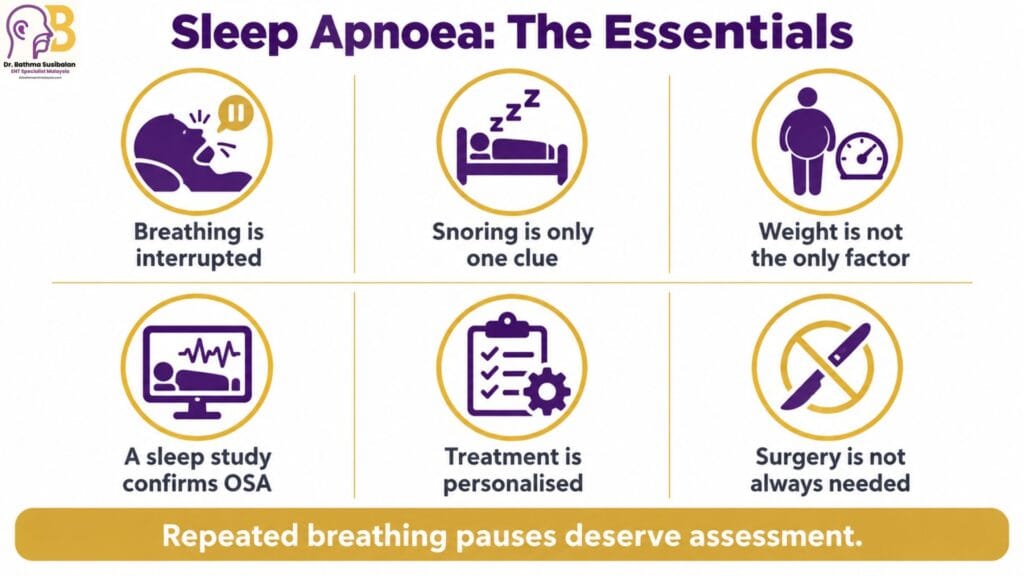
- Sleep apnoea affects your breathing while you sleep. In obstructive sleep apnoea, the upper airway repeatedly becomes too narrow or closes, reducing or stopping airflow for short periods.
- Loud snoring is one warning sign, but it is not the only one. I become more concerned when snoring is accompanied by pauses in breathing, gasping, choking, restless sleep or significant daytime sleepiness.
- You can have sleep apnoea even if you are not overweight. Weight is an important risk factor, but the shape of your nose, tonsils, palate, tongue, throat and jaw can also affect how easily your airway becomes obstructed.
- A sleep study helps confirm the diagnosis. Your symptoms and an ENT examination provide important clues, but a sleep study can show how often your breathing is interrupted and how severe the sleep apnoea is.
- Treatment is not the same for everyone. Depending on the cause and severity, treatment may include weight management and lifestyle changes, CPAP, an oral appliance, treatment for nasal blockage or selected ENT surgery.
- Having sleep apnoea does not automatically mean you need surgery. When I consider surgery, I first want to understand where the airway is narrowing and whether there is a specific anatomical problem that can reasonably be treated.
- Do not ignore repeated breathing pauses or severe daytime sleepiness. If your partner regularly sees you stop breathing while you sleep, or you are struggling to stay awake while driving, arrange a medical assessment.
The most important question is not simply “How do I stop snoring?”
It is “Is my breathing being affected while I sleep, and why?” Once we understand that, we can decide what treatment makes sense for you.
What Is Obstructive Sleep Apnoea?
When you are awake, muscles around the throat help keep the upper airway open. During sleep, these muscles naturally relax. In most people this does not cause a problem. In someone with obstructive sleep apnoea, however, the airway becomes too narrow or temporarily closes. Airflow is reduced or stops even though the body is still trying to breathe.
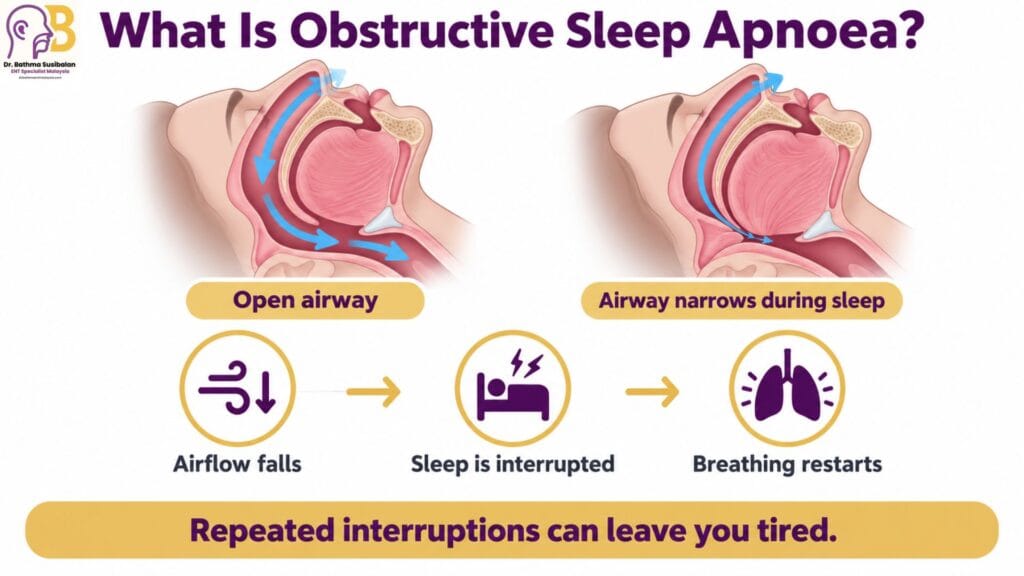
What actually happens to your breathing while you sleep?
A typical obstructive episode can happen like this:
- You fall asleep and the muscles around the throat relax.
- The upper airway becomes narrower or closes.
- Airflow falls or temporarily stops.
- Oxygen levels may fall and the brain detects that breathing is being affected.
- The brain briefly moves you into lighter sleep so the airway can reopen.
- Breathing restarts, sometimes with a gasp, snort or choking sound.
This may happen repeatedly through the night. You may not remember waking at all. That is why someone can be in bed for many hours and still feel exhausted the next day.
Why can OSA make you feel tired even after a full night in bed?
Good sleep is not only about the number of hours you spend in bed. Your brain and body also need enough continuous, restorative sleep. If breathing keeps being interrupted, sleep becomes fragmented. You may spend eight hours in bed but still miss out on the quality of sleep you need to feel refreshed and alert.
Repeated obstruction can also cause oxygen levels to fluctuate. This is one reason untreated OSA is associated with health problems beyond tiredness and snoring.
How Can You Tell If You Might Have Sleep Apnoea?
Many people do not realise they have OSA because the clearest signs happen while they are asleep. A husband, wife or family member often notices the problem first. I usually ask about both nighttime and daytime symptoms because the combination gives a much clearer picture.
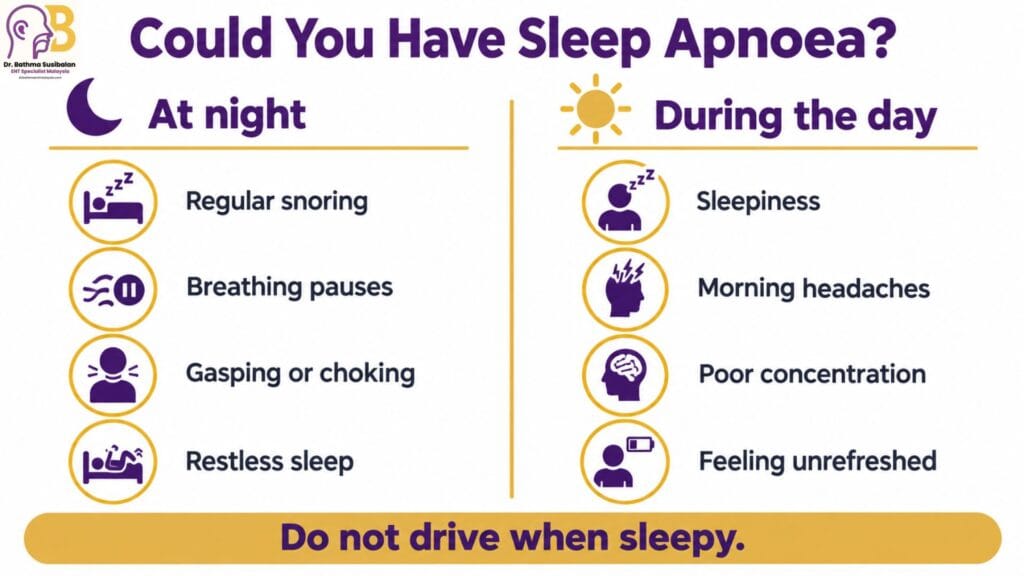
What symptoms may happen while you are sleeping?
- Loud, regular or worsening snoring
- Pauses in breathing noticed by someone else
- Gasping, choking or snorting during sleep
- Restless or disturbed sleep
- Repeated waking during the night
- Waking with a dry mouth or sore throat
- Mouth breathing, especially if the nose is often blocked
A classic pattern is loud snoring followed by a period of silence, then a sudden gasp or snort when breathing restarts. Snoring alone does not prove that you have sleep apnoea, but snoring with witnessed breathing pauses is much more concerning.
What symptoms might you notice during the day?
- Feeling unrefreshed even after what seems like enough sleep
- Excessive daytime sleepiness
- Morning headaches
- Difficulty concentrating or remembering things
- Reduced alertness or poorer work performance
- Irritability or changes in mood
- Falling asleep easily while reading, watching television or sitting quietly
Daytime sleepiness becomes a safety issue if you feel drowsy while driving. If that is happening, do not drive when sleepy. Arrange a medical assessment rather than trying to push through it.
Can you have sleep apnoea without very loud snoring?
Yes. Loud snoring is common in OSA, but it is not present in every patient. Some people mainly complain of poor-quality sleep, morning headaches, tiredness or difficulty concentrating. Women may sometimes present with less obvious symptoms, which can make the condition easier to miss.
Is It Just Snoring, or Could It Be Sleep Apnoea?
This is one of the most useful distinctions to make. Simple snoring happens when tissues in the upper airway vibrate as air passes through. It can be very loud and still not mean that breathing is repeatedly stopping. Obstructive sleep apnoea is different because airflow is being reduced or blocked again and again during sleep.
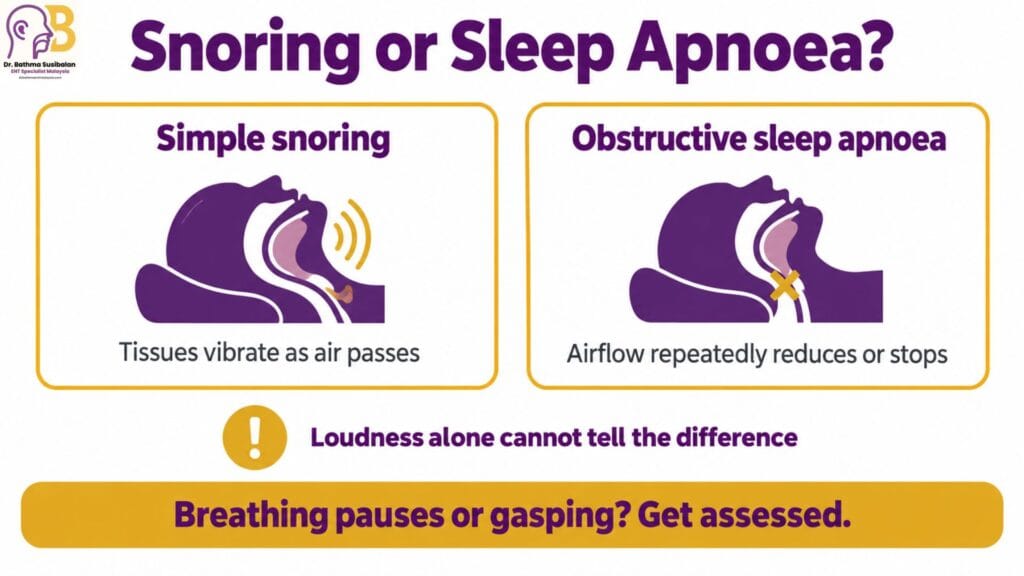
I become more suspicious of OSA when snoring is accompanied by witnessed breathing pauses, gasping, choking, repeated waking or marked daytime sleepiness. A partner may describe a cycle where the snoring suddenly stops, there is an uncomfortable silence, and then breathing restarts with a gasp. That pattern is much more important than the volume of the snoring itself.
If your only symptom is occasional snoring and you wake feeling well, the situation may be quite different from someone who is exhausted every day or has been seen to stop breathing. This is why I do not recommend choosing treatment based on snoring alone. Before trying an anti-snoring device or considering surgery, it is better to work out whether there is underlying sleep-disordered breathing and whether a sleep study is needed.
In other words, the question is not simply, “How do I stop snoring?” It is, “Is my breathing being affected while I sleep?” Once we answer that, the next steps become much clearer.
What Causes Obstructive Sleep Apnoea?
OSA usually develops because several factors make the upper airway more likely to narrow or collapse during sleep. Weight can be part of the picture, but it is not the whole story. The shape and size of the airway matter too.
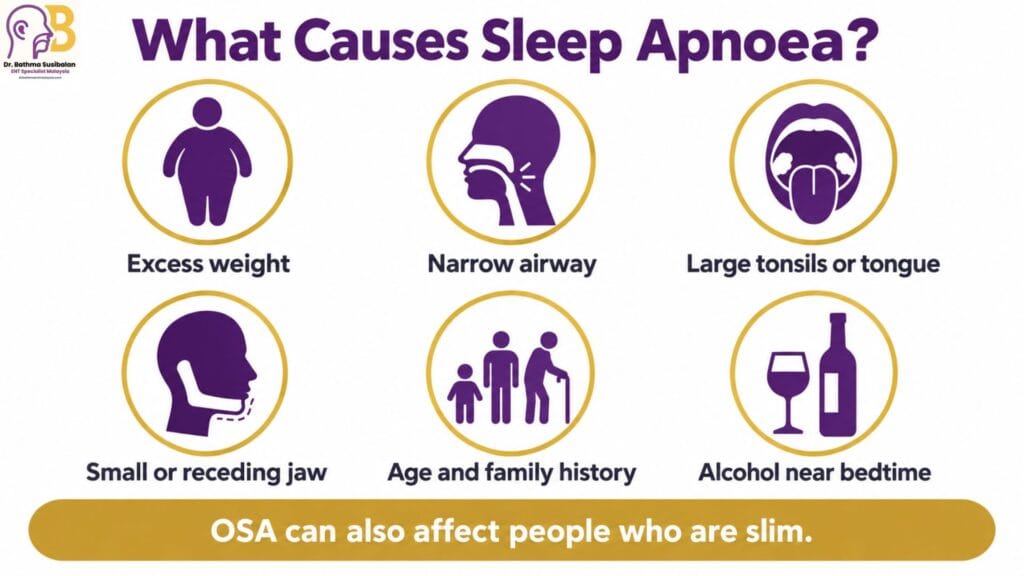
Does being overweight cause sleep apnoea?
Excess body weight is an important risk factor. Tissue around the neck and upper airway can reduce the space available for airflow and make collapse more likely during sleep. If weight is contributing to OSA, weight reduction may improve the condition.
But I do not want patients to assume that only people who are overweight can develop sleep apnoea. I also see patients who are slim or physically fit but have a naturally narrow airway or another anatomical reason for obstruction.
Can your nose, tonsils, tongue or jaw contribute to OSA?
Yes. This is where an ENT assessment can be particularly helpful. I look for features that may reduce the space available for breathing, including a blocked nose, enlarged tonsils, a bulky soft palate, a relatively large tongue, a small or receding lower jaw, or narrowing deeper in the throat.
Nasal problems such as allergic rhinitis, enlarged turbinates, a deviated septum or nasal polyps may add to airway resistance. Nasal blockage does not necessarily cause OSA by itself, but it can worsen snoring and make treatments such as CPAP harder to tolerate.
If blocked nose or sinus symptoms are a major part of your problem, you may also find my guide to sinusitis and nasal symptoms helpful.
What else can increase your risk?
Risk tends to increase with age, and OSA is more common in men, although women can certainly develop it. Family history can matter because facial structure, jaw shape and airway anatomy can run in families. Alcohol close to bedtime can relax the upper-airway muscles and make obstruction or snoring worse. Smoking can irritate and inflame the upper airway.
This is why I prefer to assess the whole picture rather than judge risk from appearance alone. Two people of the same age and weight can have very different airways and very different sleep-study results.
What Can Happen If Sleep Apnoea Is Left Untreated?
Patients often ask me whether sleep apnoea is really dangerous or whether it is simply a snoring problem. The answer depends on the severity of the condition, but OSA is more than noise.
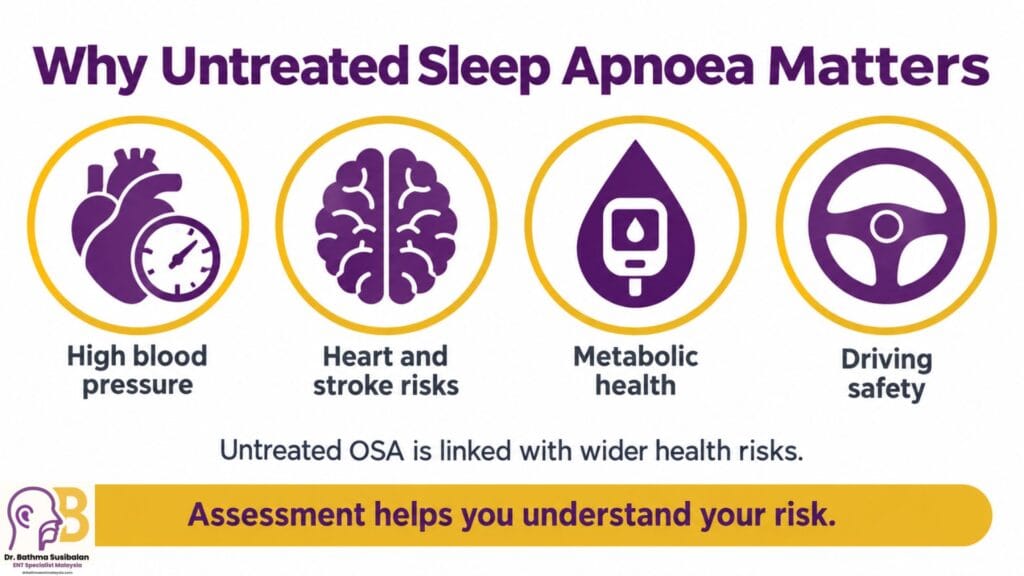
Untreated OSA is associated with high blood pressure and increased cardiovascular risk. It has also been linked with problems such as heart disease, stroke and metabolic conditions including type 2 diabetes. The repeated drops in oxygen and the stress created by disrupted breathing may place extra strain on the body over time.
There is also the very practical effect of poor sleep. Severe daytime sleepiness can affect concentration, work performance, mood and driving safety. A person who is repeatedly falling asleep at the wheel is not simply tired. That situation needs to be taken seriously.
I do not use these risks to frighten patients. I explain them because they are the reason we should not dismiss persistent symptoms. If OSA is present, the goal is to identify it, understand how severe it is and choose a treatment that you can realistically use.
When Should You See an ENT Specialist About Snoring or Sleep Apnoea?
You do not need to see an ENT specialist for every occasional night of snoring. I would be more concerned when there is a clear pattern, especially if someone else has noticed your breathing stopping.
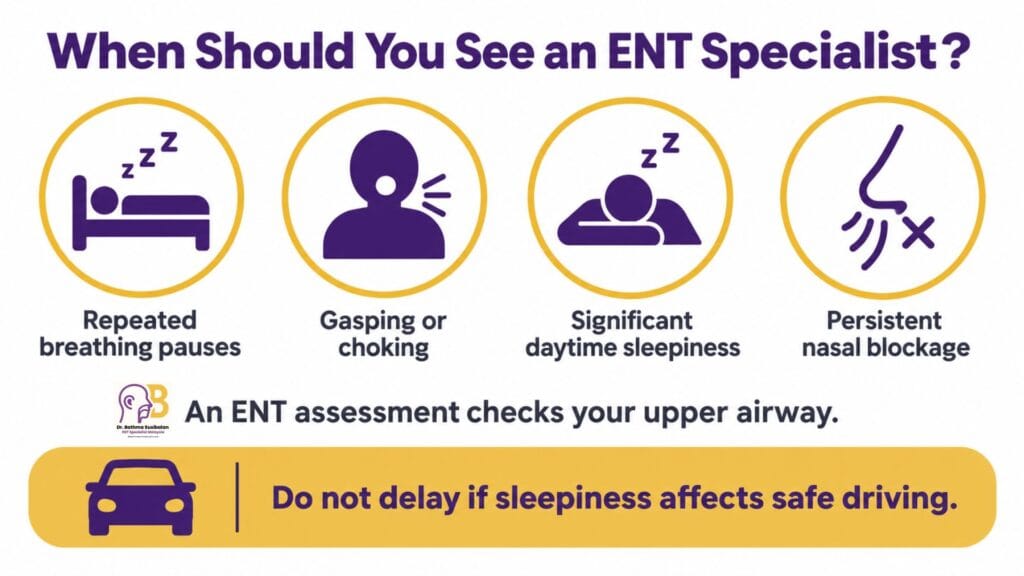
Consider arranging an assessment if you have:
- Loud, regular snoring on most nights
- Repeated pauses in breathing while asleep
- Gasping, choking or snorting during sleep
- Significant daytime sleepiness despite apparently getting enough sleep
- Morning headaches together with snoring or poor-quality sleep
- Difficulty concentrating or staying alert
- Persistent nasal blockage or difficulty breathing through the nose
- Snoring that has become noticeably worse
- Sleepiness that affects safe driving or daily activities
Why see an ENT specialist?
Obstructive sleep apnoea is an upper-airway problem, so I want to see whether anything in the nose, tonsils, palate, tongue, throat or jaw is contributing. That does not mean I will recommend surgery. In many patients, the first step is simply to understand the airway and decide whether a sleep study is needed.
If someone has repeatedly seen you stop breathing while asleep, or if your daytime sleepiness is becoming severe, I would not put off an assessment.
How Do I Diagnose Obstructive Sleep Apnoea?
I do not diagnose sleep apnoea from snoring alone. A proper assessment combines your symptoms, risk factors, examination findings and, when appropriate, a sleep study. I am trying to answer three questions: Do you have OSA? How severe is it? What may be contributing to the obstruction?
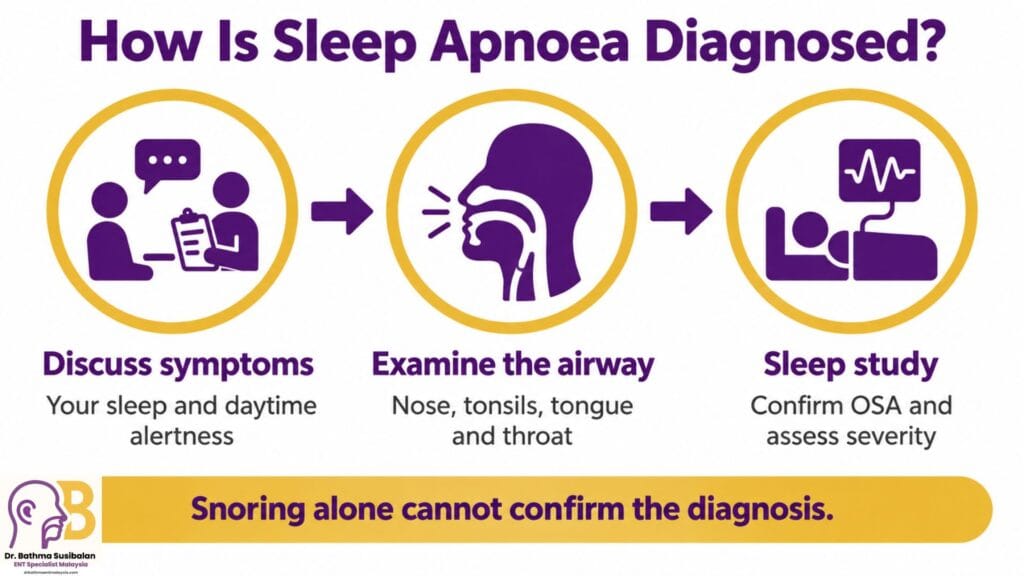
What will I ask you during the consultation?
I usually start with the story of your sleep. I may ask how often you snore, whether anyone has seen you stop breathing, whether you wake choking or gasping, how refreshed you feel in the morning, whether you get headaches, how sleepy you are during the day and whether your nose is often blocked.
If your spouse or partner has witnessed what happens at night, their observations can be very useful. They often describe events that the patient has no memory of at all.
What do I look for during an ENT examination?
I examine the upper airway to look for areas that may be reducing the space available for airflow. Depending on the patient, this may include the nose and septum, tonsils, mouth, soft palate, tongue, throat and jaw.
The examination does not replace a sleep study, but it helps me understand why obstruction may be happening and whether an ENT problem is likely to influence the treatment plan.
Do you need a sleep study?
A sleep study is one of the main ways we confirm OSA and measure its severity. Depending on your symptoms and medical history, testing may take place overnight in a sleep centre or, in selected adults, with a suitable home sleep apnoea test.
The study records breathing-related information during sleep. Depending on the type of test, this may include airflow, oxygen levels, heart rate, breathing effort, snoring and other sleep signals. A full overnight laboratory study is called polysomnography.
The value of the test is that it shows what is actually happening through the night. Two people may both snore loudly, but one may have simple snoring while the other has repeated airway obstruction and oxygen drops that require treatment.
What does your AHI score mean?
You may hear the term Apnoea-Hypopnoea Index, or AHI. It describes how often significant breathing interruptions happen per hour of sleep. An apnoea is a period when airflow stops, while a hypopnoea is a substantial reduction in airflow.
The AHI helps classify the severity of OSA, but I do not make treatment decisions from that number alone. Your symptoms, oxygen levels, general health, airway examination and ability to use different treatments also matter.
When might I recommend a closer look at the airway?
In selected patients, particularly when surgery is being considered, a more detailed assessment may help show where the airway is collapsing during sleep. One option is drug-induced sleep endoscopy, or DISE. During DISE, the airway is examined with a small flexible camera while the patient is sedated to mimic sleep. It is not needed for everyone. I would only consider it when the result is likely to change treatment planning.
How Is Obstructive Sleep Apnoea Treated?
There is no single treatment that is right for every patient. The best plan depends on the severity of OSA, your symptoms, your general health, your weight, where the airway is narrowing and which treatments you can use comfortably and consistently.
When patients ask me, “What is the best treatment?”, my answer is usually that we first need to understand why the airway is narrowing. Once we know that, we can choose treatment more intelligently.
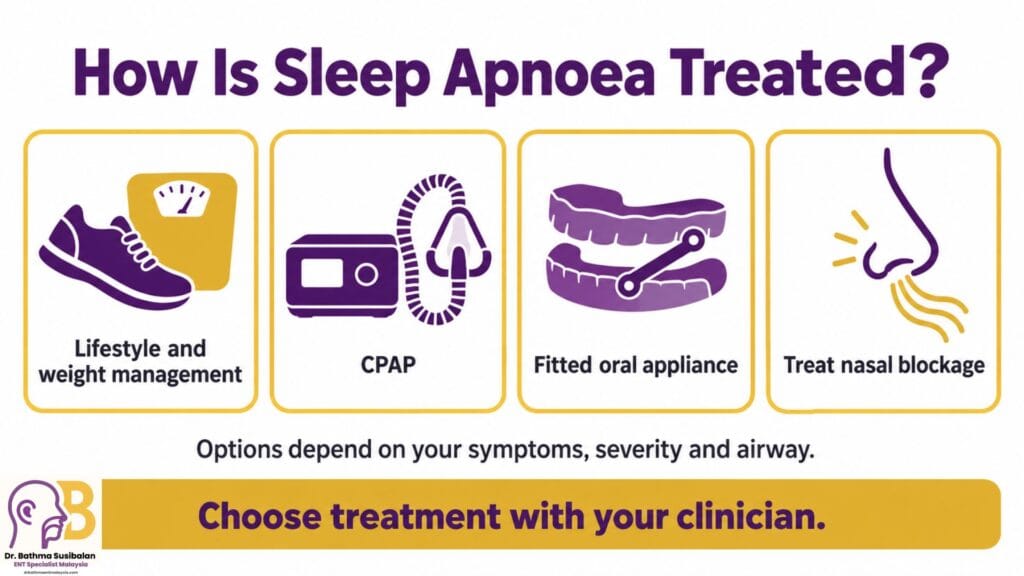
Can weight loss and lifestyle changes help?
If excess weight is contributing to OSA, weight reduction may help reduce pressure around the upper airway. Regular exercise, maintaining a healthy weight, avoiding alcohol close to bedtime and stopping smoking can also be useful parts of treatment.
These measures may improve OSA, particularly in selected patients, but they do not automatically replace other treatment when the condition is significant. If you have been prescribed treatment, do not stop it simply because you have started losing weight. Reassessment is the safer way to decide whether anything should change.
Do you always need CPAP?
No, but CPAP is one of the most established and effective treatments for OSA. CPAP stands for Continuous Positive Airway Pressure. A machine delivers gentle air pressure through a mask while you sleep. That pressure helps prevent the upper airway from collapsing.
For many patients, CPAP controls obstructive breathing very well when it is used consistently. The challenge is that some people need time and support to get comfortable with the mask and pressure.
What if you cannot tolerate CPAP?
I do not like patients to assume that CPAP has “failed” after a few uncomfortable nights. First, we should work out what is making it difficult. Sometimes the mask fit is poor. Sometimes the pressure needs adjustment. Sometimes the nose is so blocked that using the machine becomes unpleasant.
If nasal obstruction is part of the problem, treating it may make CPAP easier to use. The aim is not to force one treatment on everyone. It is to make sure we have solved the right problem before giving up on an effective therapy.
Can an oral appliance help?
An oral appliance may be suitable for selected patients, including some people with mild to moderate OSA and some patients who cannot tolerate positive-airway-pressure therapy. These devices are designed to move the lower jaw or tongue forwards so there is more space behind it for airflow.
I would not treat a diagnosed sleep disorder with an ordinary over-the-counter anti-snoring device. If an oral appliance is being used for OSA, it should be properly fitted, selected for the right patient and followed up appropriately.
Can ENT Surgery Treat Obstructive Sleep Apnoea?
Yes, surgery can play an important role in treating obstructive sleep apnoea in selected patients. But it is not the right treatment for everyone.
When I consider ENT surgery for sleep apnoea, I am not simply looking at whether you have been diagnosed with OSA. I want to know where your airway is narrowing or collapsing while you sleep.
For one person, the main problem may be very large tonsils. Another may have significant nasal obstruction. Someone else may have narrowing around the soft palate, throat or tongue. Some patients have obstruction at several levels.
This is why the same operation is not suitable for every patient with sleep apnoea.
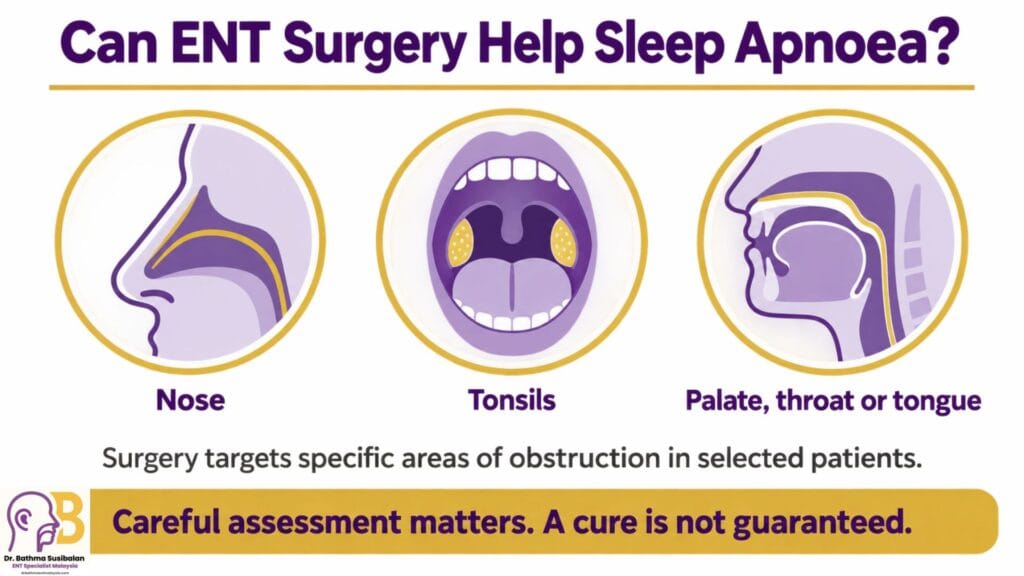
When Might Surgery Be Considered for Sleep Apnoea?
Surgery may be considered when I identify a clear anatomical problem in the upper airway that can reasonably be treated.
It may also be worth discussing in selected patients who:
- Have significant obstruction in the nose, tonsils, palate, throat or tongue
- Continue to have problems despite other treatment
- Cannot tolerate CPAP despite appropriate attempts to make it more comfortable
- Have difficulty using CPAP because of significant nasal obstruction
- Have an airway structure that makes a particular surgical treatment potentially helpful
Surgery should never be the automatic next step simply because somebody snores.
Before recommending an operation, I want to understand the severity of the sleep apnoea, the patient’s symptoms, their sleep study results and, importantly, the anatomy of their airway.
Can Treating a Blocked Nose Help?
If you have significant nasal blockage, the first step is to understand what is causing it.
Common causes include:
- Allergic rhinitis
- A deviated nasal septum
- Enlarged turbinates
- Nasal polyps
- Chronic nasal inflammation
Some of these problems can be managed with medication. Structural obstruction may sometimes require a procedure.
Improving nasal breathing can make sleeping more comfortable and may also make CPAP easier to use.
However, I explain to patients that nasal surgery does not automatically cure obstructive sleep apnoea. The nose may be one part of the problem, while obstruction may also be occurring further down the airway.
Can Removing Large Tonsils Help Sleep Apnoea?
Large tonsils can take up a considerable amount of space at the back of the throat.
In selected adults where the tonsils are an important source of obstruction, tonsil surgery may form part of treatment.
Enlarged tonsils and adenoids are also a common cause of obstructive sleep apnoea in children.
The important question is not simply whether the tonsils look large. I need to consider whether they are actually contributing significantly to the airway obstruction.
What About Surgery to the Palate, Throat or Tongue?
Some patients have obstruction around the soft palate or throat. Others experience narrowing further down around the tongue or tongue base.
There are different ENT procedures that can be used to create more space or reduce collapse in these areas.
I do not believe in choosing an operation first and then trying to make the patient fit the procedure.
It should be the other way around.
First, we identify where the airway is obstructing. Then we decide whether there is a procedure that appropriately addresses that particular problem.
In some patients, more than one area of the airway contributes to the sleep apnoea, so treatment may need to address more than one level.
How Do I Know Which Sleep Apnoea Surgery Is Right for Me?
This is where a detailed ENT assessment becomes particularly important.
I will examine the nose, tonsils, palate, tongue, throat and other parts of the upper airway. Your sleep study also helps me understand how significant the sleep apnoea is.
In selected cases, further airway assessment may be useful if we need a clearer picture of where collapse is happening during sleep.
The purpose is to answer a very practical question:
What is actually blocking your airway, and can treating that obstruction meaningfully improve your sleep apnoea?
Can Surgery Cure Obstructive Sleep Apnoea?
This is a question patients understandably ask me.
Surgery can significantly improve obstructive sleep apnoea in appropriately selected patients, and some people may achieve very good control of their condition.
But I would not describe any operation as a guaranteed cure for everyone.
The result depends on several factors, including:
- The severity of your sleep apnoea
- Where the airway is narrowing
- Whether there is obstruction at one or several levels
- Your weight and general health
- The particular procedure performed
- Other factors contributing to your OSA
This is why careful patient selection matters so much.
How Do You Know If Your Sleep Apnoea Treatment Is Working?
Patients often notice changes such as less snoring, fewer episodes of choking or gasping, better energy, clearer concentration and less daytime sleepiness. Those changes are encouraging, but feeling better does not always prove that OSA is fully controlled.
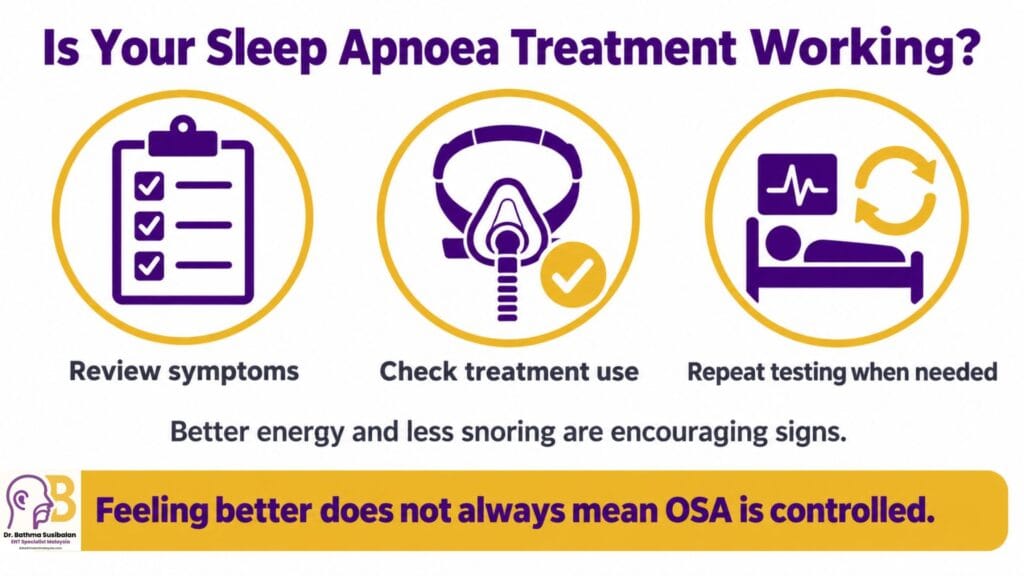
Follow-up may include reviewing your symptoms, checking how well you are using CPAP or another treatment and, in some situations, repeating a sleep study. This may be considered after major weight change, after airway surgery, when symptoms return or when there has been a major change in treatment.
Sleep apnoea can also change over time. Weight can change, nasal obstruction can worsen, other health problems can develop and CPAP tolerance can change. If a treatment becomes difficult to use or old symptoms come back, I would rather review the situation than have you quietly stop treatment.
The goal is better breathing and safer, more restorative sleep. A quieter bedroom is welcome, but it is not the only measure of success.
Here’s What To Do If You Think You May Have Sleep Apnoea
The first thing I would say is: do not judge the problem by the loudness of the snoring alone.
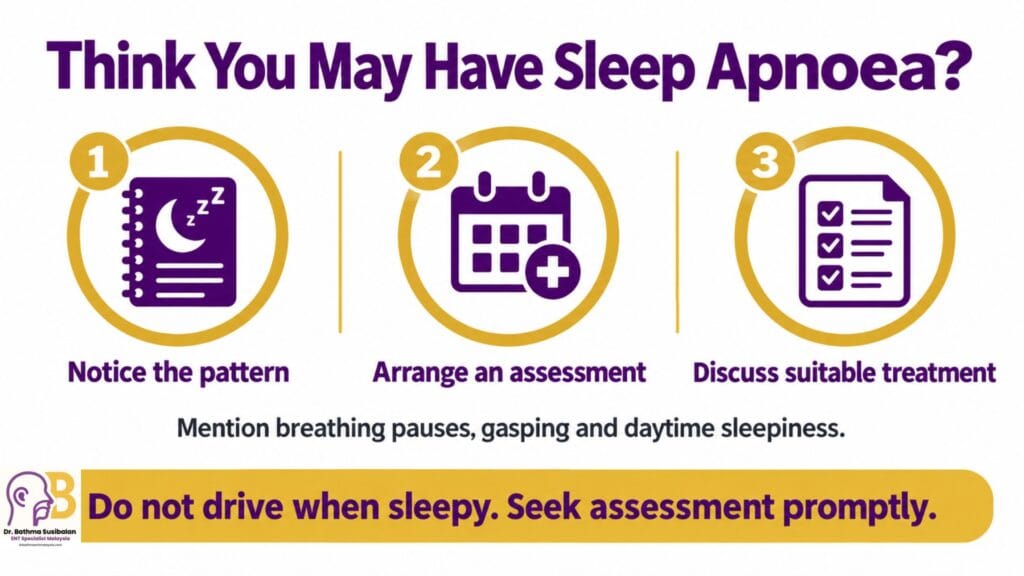
Some people snore and do not have OSA. Others have repeated obstruction that is affecting their breathing, oxygen levels and quality of sleep. What matters is the pattern. If your spouse keeps seeing you stop breathing, if you wake choking, or if you are exhausted every day despite spending enough time in bed, find out what is happening.
I also do not want patients to feel that a diagnosis automatically means they will be told to use CPAP or have surgery. Treatment should follow the diagnosis. My job is to understand your airway, your sleep-study findings, your symptoms and your health, then explain which options make sense for you.
If you have already tried CPAP and found it difficult, tell me what happened. Sometimes there is a practical problem that can be improved. If surgery is being considered, I want to be clear about which part of the airway we are trying to treat and what the procedure can realistically achieve.
Most of all, take severe daytime sleepiness seriously. If you are struggling to stay awake while driving, avoid driving when sleepy and arrange medical assessment promptly. Sleep apnoea is treatable, but the first step is recognising that poor sleep and repeated breathing pauses are not something you simply have to live with.
About The Author
Dr. Bathma Susibalan
Dr. Bathma Dhevi Susibalan is a consultant ENT (Ear, Nose & Throat) specialist with over 17 years of expertise in Otorhinolaryngology as an ENT surgeon.
She offers exceptional surgical and non-surgical treatments for ear, nose & throat conditions for chilren & adults, based out of KPJ Klang Specialist Hospital (Selangor, Malaysia).


Get Help Today
Contact me by phone or via the booking form to schedule your visit, choosing a convenient date and time. You will receive confirmation and reminders promptly.
Dr. Bathma
Visit my clinic on your scheduled date to discuss your concerns and symptoms with me. I will conduct a thorough examination and provide an initial diagnosis.
Review your personalized treatment plan and understand the recommended procedures and their benefits. Begin your journey to recovery with my expert care.
Frequently Asked Questions

Contact & Request Appointment
Schedule a consultation by using the form below, or calling her clinic or using the online booking button.
Please note that consultation is ONLY by appointment – no walk-ins.
Appointment Form
Clinic Contact
Tel: +603-33777888 (Ext: 7006)
Mobile: +6011-1623 4708
Suite Level 3A, KPJ Klang Specialist Hospital 102, Persiaran Rajawali/KU 1, Bandar Baru Klang, 41150 Klang, Selangor, Malaysia
Mon – Fri: 08:30 – 17:00
Sat: 08:30 – 12:30
Sun & Holidays: closed
 English (UK)
 Bahasa Melayu
 தமிழ்
